Unity Netcode FPS Prototype
A multiplayer FPS prototype built using Unity Netcode for GameObjects, implementing a semi-authoritative client-server architecture with client-side movement and server-side validation to handle latency and desync.
Overview
This project is a real-time multiplayer FPS prototype developed in Unity using Netcode for GameObjects. It focuses on implementing a client-server networking model capable of handling player movement, shooting, and state synchronisation.
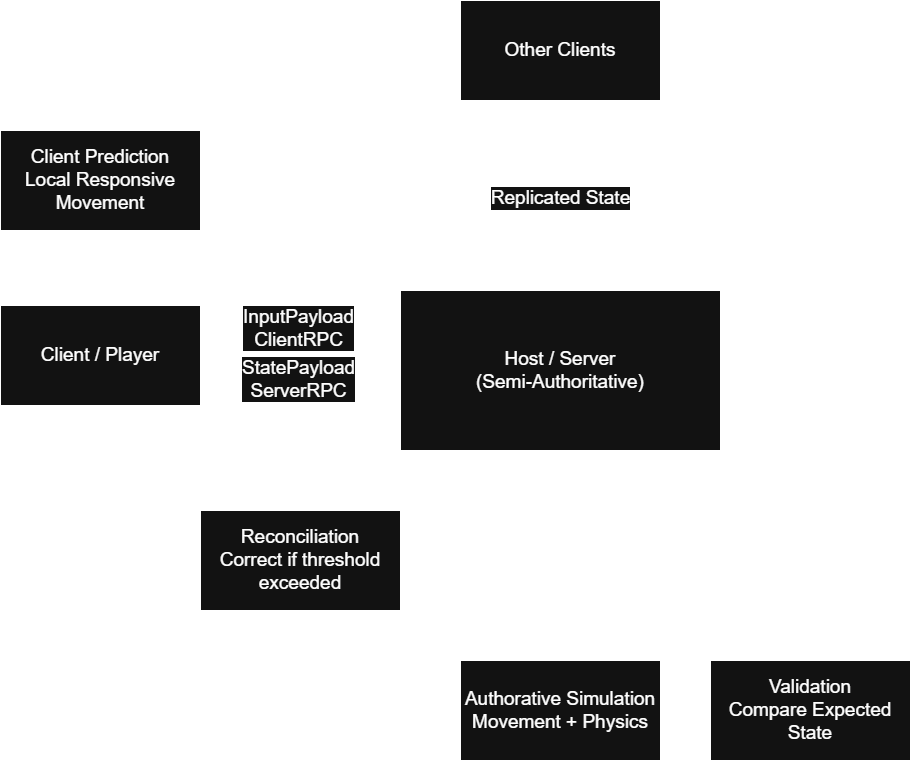
The system explores the trade-offs between responsiveness and authority, using a semi-authoritative approach where clients control immediate movement while the server validates and corrects discrepancies.
Goals
The primary goal was to design a multiplayer system that feels responsive to the player while maintaining server authority to ensure consistency and prevent invalid state changes.
The project aimed to explore how real-time gameplay systems behave under network constraints, particularly in fast-paced FPS interactions.
My Contribution
- Designed and implemented the client-server networking model
- Developed player movement synchronisation with client authority and server validation
- Implemented shooting mechanics and state replication
- Managed network communication using Unity Netcode for GameObjects
- Evaluated latency and consistency trade-offs in real-time gameplay
System Architecture
Client-Side Control
Clients handle immediate player input and movement locally to ensure responsive gameplay.
Server Validation
The server verifies client-reported state and corrects discrepancies beyond acceptable thresholds.
State Synchronisation
Player state, including position and actions, is synchronised across clients through network updates.
Network Messaging
Communication between client and server is handled through RPCs and network variables provided by Netcode for GameObjects.
Technical Deep Dive
Semi-Authoritative Movement
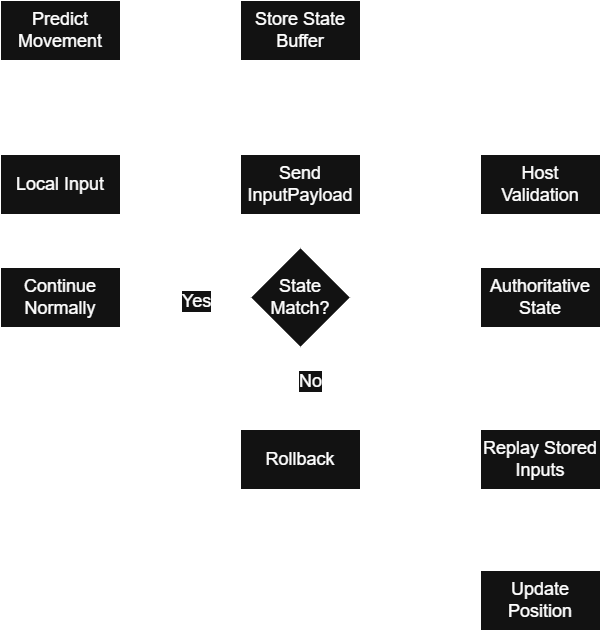
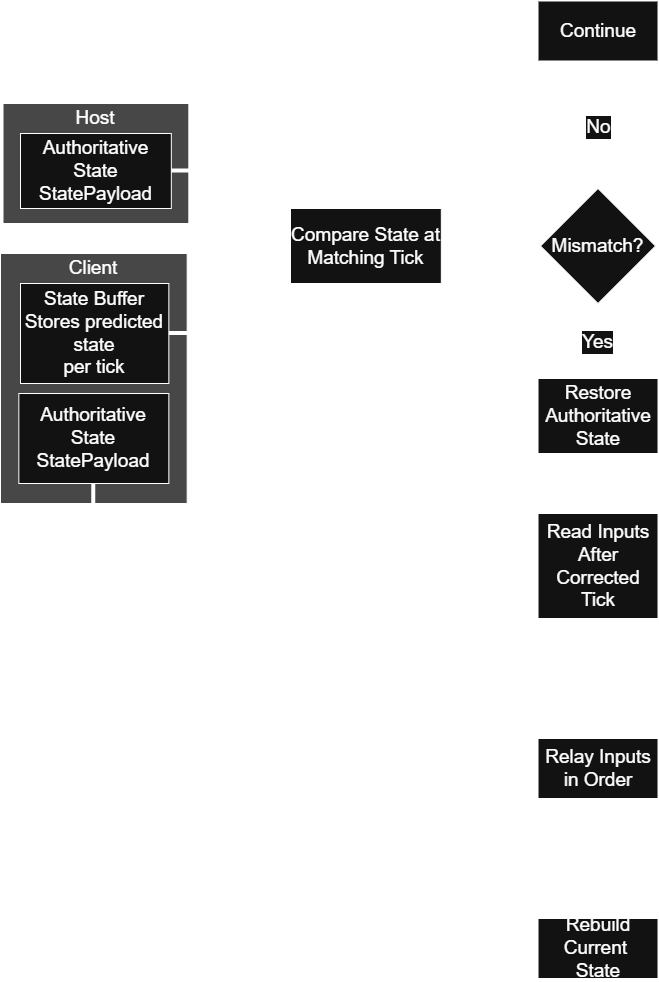
Player movement is handled locally on the client to ensure responsiveness. The server receives movement updates and validates them against expected constraints, correcting positions if deviations exceed a defined threshold.
State Synchronisation
Player state is synchronised across the network using Netcode components, keeping remote clients updated with relevant movement and gameplay state. The implementation focuses on transmitting necessary state changes without treating every local update as equally important.
RPC-Based Communication
Remote Procedure Calls are used to transmit gameplay actions such as shooting and movement updates between client and server. This separates immediate local feedback from validated networked state changes.
Latency Considerations
The system balances responsiveness and consistency by allowing immediate local feedback while relying on server validation to correct invalid or excessive deviations caused by latency or desynchronisation.
Challenges and Solutions
Balancing Responsiveness and Authority
Fully server-authoritative movement introduced noticeable input delay, while fully client-authoritative movement risked inconsistencies.
A semi-authoritative approach was adopted, allowing responsive local control with server-side validation.
Synchronising Fast-Paced Gameplay
FPS gameplay requires accurate and timely updates for player actions.
This was addressed through efficient state updates and prioritising critical gameplay events such as shooting.
Handling Network Discrepancies
Differences between client and server state can occur due to latency.
The system corrects these discrepancies when they exceed acceptable thresholds, maintaining overall consistency.
Performance and Optimisation
Network traffic is minimised by only synchronising necessary state changes and using efficient messaging patterns.
The system prioritises responsiveness for local player actions while maintaining acceptable consistency across clients.
Results
The prototype successfully demonstrates a functional real-time multiplayer FPS with responsive controls and consistent state synchronisation across clients.
It highlights the trade-offs involved in networking fast-paced gameplay systems and provides a foundation for further development of multiplayer features.
Future Improvements
- Client-side prediction and server reconciliation
- Lag compensation for shooting mechanics
- Interpolation and smoothing for remote players
- More robust anti-cheat validation
- Scalability improvements for larger player counts
Technical Gallery